Peptide Purity Testing Explained Through HPLC and Mass Spec
How HPLC and mass spectrometry measure peptide purity and identity, why net peptide content is a separate test and which factors drive testing cost.
On this page · 5 sections
Peptide purity testing usually combines two methods: high performance liquid chromatography, which separates the target peptide from related impurities and reports their share as a percentage, and mass spectrometry, which confirms that the main peak has the right molecular weight. Neither method alone shows how much peptide a vial holds or whether it is sterile. This guide explains how each technique works in the laboratory, what a purity figure can and cannot prove, why net peptide content is a separate measurement and which factors drive testing cost. It is written for research education only.
How HPLC Separates a Peptide From Its Impurities
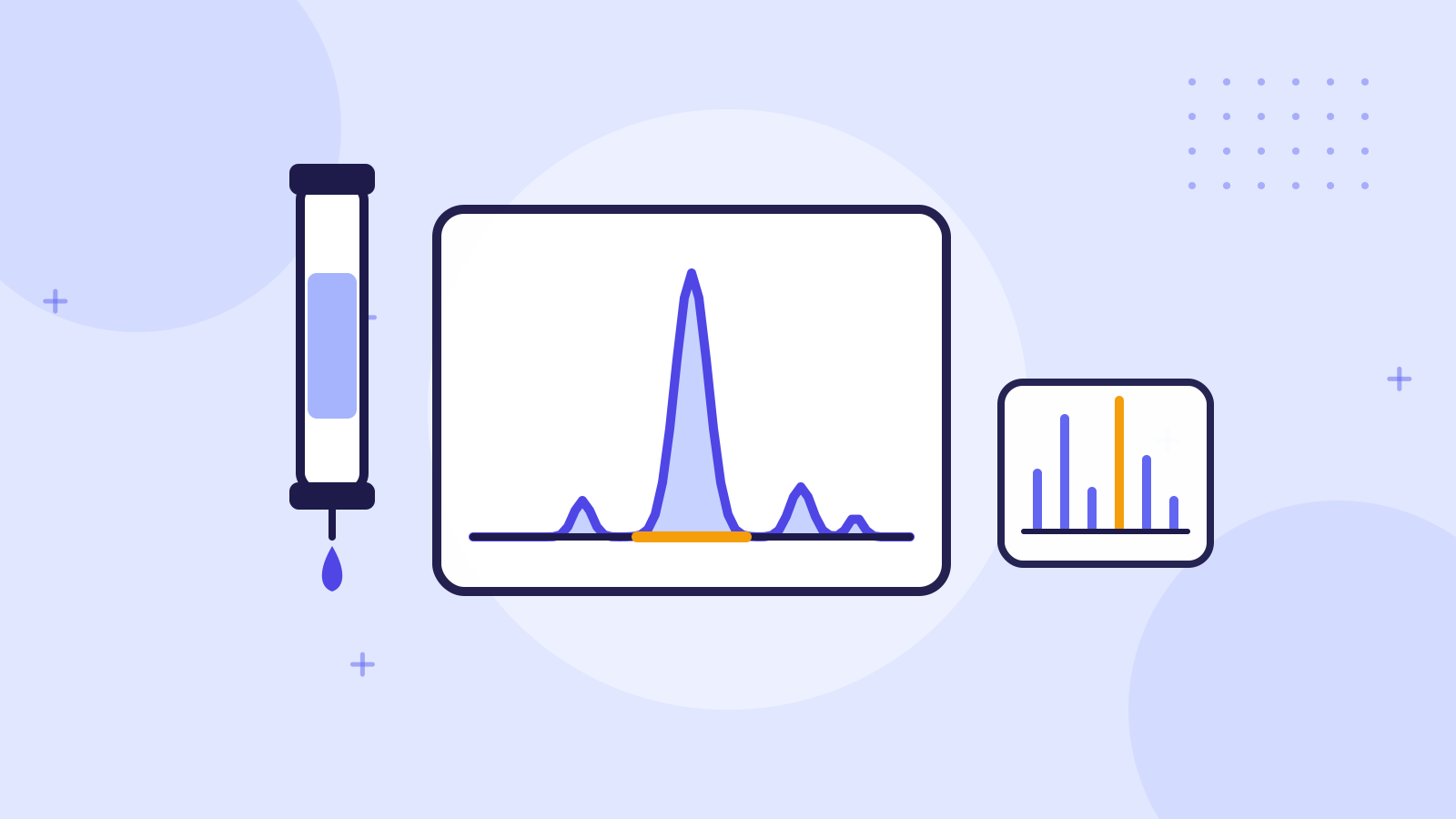
High performance liquid chromatography, or HPLC, pushes a dissolved sample through a narrow column packed with tiny coated particles. For peptides, the usual setup is reversed phase: the particles carry an oily coating, and the liquid flowing through starts watery and becomes steadily richer in an organic solvent such as acetonitrile. Each molecule sticks to the coating to a different degree, so they leave the column at different times. A detector at the outlet, usually measuring ultraviolet light absorbed by the peptide bonds, records each molecule as a peak on a graph called a chromatogram. The target peptide should form the largest peak, with smaller peaks for anything else.
The purity figure is the area of the main peak divided by the total area of all peaks, expressed as a percentage. Those smaller peaks are often close relatives of the target. A review of impurities in peptide medicines grouped them into synthesis errors, such as chains missing or carrying an extra amino acid, leftover protecting groups and mirror image forms, and degradation products formed later through oxidation and other chemical changes. Many differ from the main peptide by a single amino acid and can hide under the main peak if the method is not tuned well. That is why a purity result is only as good as the method behind it, including the column, gradient and the way peaks are integrated.
What Mass Spectrometry Adds to a Purity Result
HPLC shows how many different things are in a sample and in what proportions, but it cannot say what the main peak actually is. Mass spectrometry answers that question. The instrument turns molecules into charged particles, usually by spraying the liquid into a strong electric field, and then measures their mass to charge ratio. For a peptide, the result can be compared with the mass calculated from its known amino acid sequence. A match confirms identity; a mismatch reveals a wrong sequence, a missing amino acid or an unexpected modification. When the two instruments are linked, a set up called LC-MS, each HPLC peak can be identified as it leaves the column.
A 2021 review of synthetic peptide analysis described LC-MS as the central tool for finding and characterising impurities, while warning of pitfalls. Some impurities share exactly the same mass as the target, such as forms that contain a mirror image amino acid, so mass alone cannot separate them and the chromatography must do that work. Others fragment or form clusters inside the instrument and can be misread. Tandem mass spectrometry, which breaks a selected molecule into pieces to read its sequence, adds further certainty. In practice, a credible report pairs an HPLC purity figure with a mass spectrum that matches the expected mass for the specific batch tested, rather than a generic spectrum reused for every lot.
| Method | Question it answers | What it misses |
|---|---|---|
| Reversed phase HPLC with UV detection | What share of detected material is the main peak | Identity of the peak, water, salts, total amount |
| Mass spectrometry | Does the main component have the expected mass | Proportions, impurities with identical mass |
| LC-MS and tandem MS | What each impurity peak is | Endotoxin, sterility, metals |
| Amino acid analysis or similar | How much peptide is in the powder by weight | Related impurities, identity of sequence |
Net Peptide Content and Why Purity Is Not Quantity
A freeze dried peptide powder is never pure peptide by weight. It contains water and counterions, the small charged molecules that pair with the peptide after purification. A common one is trifluoroacetate, left over from the acid used in synthesis and purification. Net peptide content is the share of the powder's weight that is actually peptide, and it is measured by different methods, such as amino acid analysis after breaking the peptide into its building blocks. In a 2018 study certifying an angiotensin II reference material, the trifluoroacetate counterion alone made up nearly 25 percent of the mass, and the final assigned peptide content was 691 milligrams per gram.
This is why a high HPLC purity figure does not mean a vial holds its labelled amount. A sample can show a clean main peak and still contain far less peptide by weight than the label states, or far more. Peptide purity testing must therefore be read alongside a content measurement. Independent analysis shows how large the gap can be: in a 2024 study of semaglutide vials bought from illegal online pharmacies, measured content exceeded the label by roughly 29 to 39 percent, while measured purity ranged from about 8 to 14 percent against a labelled 99 percent. A purity number on its own, without content, identity and safety tests, describes only part of the product.
What Drives Peptide Purity Testing Cost
There is no single price for peptide purity testing, because the work varies widely. A basic run with one HPLC method and one mass spectrum is the simplest request. Costs rise with each added question: a validated method for a new peptide, a certified reference standard to compare against, replicate injections to show precision, tandem mass spectrometry to identify unknown peaks, net peptide content, counterion measurement, and safety tests such as endotoxin or sterility. Blends cost more than single peptides, because each component needs its own identity and amount. Turnaround time, sample shipping and the accreditation of the laboratory also affect peptide purity testing cost, as do any formal reports and data packages requested.
Method validation is the largest hidden factor. For approved medicines, regulators expect methods to be shown fit for purpose, with checks of specificity, accuracy, precision and limits of detection, before routine results are trusted. A laboratory testing an uncommon research peptide for the first time may have no validated method and must develop one. A cheap result from an unvalidated method may look identical on paper to a costly validated one, which is why the method description matters more than the price. The most useful question to ask is not how much a test costs but which questions it actually answers, and which ones it leaves open.
Conclusion
Peptide purity testing relies on HPLC to separate a peptide from its related impurities and on mass spectrometry to confirm its identity. Together they show what share of detected material is the target, but not how much peptide a vial holds, which needs a net content measurement, nor whether it is sterile or free of endotoxin. Each extra question adds work and cost.
Sources
New articles by email
Not one issue has gone out yet. Put your address on the list for the first; a personal removal link comes with every sign-up.